
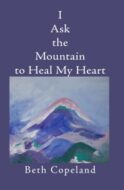
 Beth Copeland
I Ask the Mountain to Heal My Heart
Redhawk Publications
Reviewer: David E. Poston
The mountains of North Carolina and the southern Appalachians—even as their character and traditions are being eclipsed by development and battered by climate change—have been a perennial source of inspiration for writers of every genre, perhaps poets most of all. The last year or so alone has seen an edition of Robert Morgan’s Collected Early Poems, a first poetry collection from acclaimed non-fiction writer Georgeann Eubanks, and a poetic sequel from Wayne Caldwell voiced once again by a mountain native character. Add to that list recent books by Richard Betz and Britt Kaufmann (among others) that are significantly informed by the region, and it is clear that the well is not dry.
What does I Ask the Mountain to Heal My Heart add to this tradition? While Beth Copeland employs traditional tropes and images to present the healing arc her title suggests, her narrative is more nuanced and personal. The titular mountain, known simply as The Peak in Ashe County, North Carolina, is a central image, a persona—sometimes a character—throughout the book. Its geography and the flora and fauna which inhabit it evoke responses in Copeland’s narrative persona that provide the thematic energy for these poems. Physical motifs, such as driving winding mountain roads or practicing yoga, and emotional ones, such as suffering loss and recovering trust, unfold as part of the arc of healing.
The opening poem, “True North,” presents a strong, resolute tone in lines such as “A mountain, like Polaris, is a point of reference/ to keep us from becoming lost. A point of reverence,” and “We’re not lost. We’re exactly where we are.” That certainty, however, is undercut in poems that follow, as perceptions prove unreliable and the narrative persona emerges—initially—as heartbroken in the aftermath of an ended relationship.
Poems such as “He Says I Remind Him of a Deer in Headlights” and “He Yells at Me for 15 Minutes on the Phone” delineate the hurt that the speaker brings to the mountain. In “Eleven Lines in Search of a Perfect Rhyme,” a vee of Canada geese overhead sparks thoughts of what else flies away: grown children, words that “fly out of my mouth like startled birds,” deceased loved ones flying through dreams. The poem opens with the question, “Is it accidental that bereft almost rhymes with death?”; it ends with the paradoxical realization that one “can be both the lover leaving and the lover left.” Then a healing change begins, moving toward a conciliatory moment in “Vespers in Silvertone”:
As we say our prayers—you to the God you serve, / and I to the mountain, the sky, the universe— // may we find the love we couldn’t find together.”
Copeland renders her poems through layers of perception the way a deer slips through a laurel thicket: through fog or snowfall that quickly melts, at the edge of sunset, through ghostly figures appearing in a weft of dream and memory. These poems occasionally slip into cliché or prosiness, but their imagery is sharp and specific, and the emotional energy is authentic and palpable. Her command of sound is often lovely, as in these lines from her incantatory meditation, “Fog” which begins:
Morning fog erases the mountain and trees.
No, not an erasure but unseen.
Not an erasure but unseen.
The mountain, the laurel still green.
Unlike the mountain and laurel still green,
the dearly departed lie beneath white sheets.
The deer depart beneath white sheets.
The opening line is repeated at the end to round out the poem. Its note of erasure ends Section I with unanswered questions, but it also presages the healing process informing the middle three sections of the collection.
Those sections meander through family history, images of Appalachia, concerns about wildfires and pandemic, yoga and meditation, and constant interaction with the mountain. Copeland’s supporting characters include the ex-husband/ex-lover, the New River, deer who slip in and out of her vision, family members who move in and out of her dreams and memories, and her beloved dog Phoenix. The last section brings the demise of Phoenix, the appearance of her beloved, and a circling back to images from the first section.
“O Hallowed Halo,” in the third section, is a beautiful rush of images that delight the ear. That section is more mellow and meditative, with yoga-inspired poems such as “Shavasana,” which takes the speaker back to a childhood memory of floating in a pool, “eyes open to heaven, held / on the water’s shimmering surface, adrift / in that moment of wonder when we know / nothing is holding us up and we float.”
Copeland’s more conversational poems are both witty and down-to-earth and surprisingly powerful. “Buddha Buzzed” is a good example. It begins with the observation of a fly that “nosedives into the lightbulb as if it’s the sun.” When the poem asks what Buddha might say to the fly, it is hard not to take the question as tongue-in-cheek. But the train of thought leads to a striking conclusion as the speaker ponders passing
from this dimension of blood
and breath onto the land of enlightenment or samsara, only
to return as a cobra or cat or someone like me who ponders
these questions without knowing that I’m pushing against
an invisible barrier, frustrated, wringing my hands, eyes
glued to a world that lies beyond my grasp, trying to pass
through this fence of flesh to the other side of the glass.
Section IV opens with light-hearted repartee with the mountain in “Who Needs a Man When You Have a Mountain.” The poems of the section flow chronologically through fall, winter, and spring, as the speaker finds healing significance in the world around her. In “October Valentine,” she holds a heart-shaped leaf, calling it “a battered / heart, like yours, like mine, but maybe its scars make it more / beautiful than before. My friends, there’s still so much / love in this world even when you’re alone.”
In the title poem, which ends the section, a score of the collection’s central, recurring images are addressed in turn, each of them asked for healing. The poem concludes with “I ask the roses to heal my heart and they say, Go ask the moon. / But the moon’s sunlit face only smiles. So, I ask the shadow side. // Stop asking, it whispers. Bloom.”
“Beloved,” which opens the final section, is—like the book itself—dedicated to “Paul,” whom one assumes is the beloved person who appears in poems throughout this section. In “Beloved,” though, he is not physically present: “As the mountain sleeps beneath sheets of fog, / you’re here, unseen, dreaming // my dreams as I dream yours, as the river / shivers beneath its rippling.”
“Blood Moon” reprises several central motifs: driving “in widdershins on winding roads,” uncertain perceptions about the moon and sky. It ends with “Tonight I lie beside you on your blue-striped duvet. / We don’t know which way the world is turning. / In darkness, we hold each other and pray.”
“Tubing on the New River” describes the literal pitfalls and pratfalls of aging bodies navigating a river or pickleball or even walking a dog. But midway through, it turns to the hazards of falling in love (again) and declaring that love. It concludes with
When we reach the shore I slip and fall on my butt,
sitting in water up to my neck, and when you extend
your hand, you fall in, too—a slapstick cartoon!—me
falling, you falling, both of us falling deeper
as we float these green currents together.
Taken together, this pair of poems encapsulates where the healing journey has brought us: to two people falling in love together, holding each other, praying in darkness.
The final poem, “You Hand Me a Heart-Shaped Stone,” employs an image found throughout the collection, beginning with the deer hoofprints in the snow “like two halves /of an inverted heart” in the earlier poem “Hunger Moon.” In “Hunger Moon,” that image triggered a journey through dream, family memories, and recollections of the painful aftermath of divorce. In this poem, however, the speaker holds the stone and describes “how when I close my eyes I can feel the vibrations of / water and the warmth of your hand in mine, / … How you said, I will / love you always and / I said, for-/ever.”
Whether or not that is resolution, it is clearly healing.
These poems journey through heartache, self-doubt, and loss to reach that healing. Copeland guides us through the geography of her mountains, past “the JESUS BLOOD SAVES cross on Route 88” and the landscape around it. But she also knows the geography of her own heart, and she ultimately moves beyond resolution to something both riskier and more emotionally vital. In a collection that may be as much about what Copeland brings to the mountain as what she finds there, what her narrator is holding in the last poem is an emblem of faith.
