
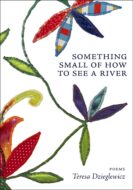
 Teresa Dzieglewicz
Something Small of How to See a River
Tupelo Press
Reviewer: Vivian Wagner
Teresa Dzieglewicz’s Something Small of How to See a River is a beautiful and moving collection of poems that explore the Standing Rock protests over the construction of the Dakota Access Pipeline and the poet’s experiences during and after this period. These poems look at the ways small moments and details of the landscape and human interactions can encapsulate much larger stories and meanings, showing that sometimes the only way to see the big picture is to look at the seemingly tiniest elements—or, as the title says, “something small” that can help to illuminate something as large and mysterious as a river itself.
In the book’s Foreword, Dzieglewicz explains how she came to be involved with the Standing Rock protests, first arriving in August, 2016 and subsequently meeting Alayna Eagle Shield and becoming involved with a school she’d founded to educate children at the camp. The poems in the book explore Dzieglewicz’s experiences alongside those of people from the Očéti Šakówiŋ tribes—the Lakȟóta, Dakȟóta, and Nakȟóta—and other activists protesting the pipeline, looking at the ways that all of their lives are intertwined with each other and with the landscape they inhabit and seek to protect..
The poems are organized into three sections that map onto the life and movement of a river: “Headwaters,” “Floodplain,” and “Confluence.” The poems in these sections are roughly chronological, following a river from its beginnings to where it merges with another river, just as the Cannonball River merges with the Missouri River, which then flows into the wider world. Rivers serve as a primary organizing principle for the book, and each of the poems are small glimpses into a river system made up not just of water, but of people and animals, culture and education, love and loss.
In the first poem in the Headwaters section, “Tonight, I Haven’t Even Said the Word Pipeline,” the speaker introduces us to the school via the process of unboxing supplies, and the poem moves from the small details of getting a school up and running toward the broader mysteries of the universe. The poem compares the school to the river itself: “say school but mean river.” It’s one of those seemingly small spaces, marked by army tents decorated with corn, that comes to embody more than itself. By the end of the poem, the speaker looks up at the vast sky above, garlanded with aurora, saying “maybe this is the most human thing we do: / look upward, together, as the light changes from green to pink.” It’s one of the many moments in this collection when the small transitions seamlessly into a large and mysterious universe.
Sometimes, these moments have a humorous element, as in “The Naming of Facebook Hill,” in which Ricardo, the camp cartoonist, tells about seeing a “silhouette / of an old man praying on the tallest hill.” He says the man looked like he was communing with nature, describing “how he spun / slow in back and forth semi-circles,” and how “the man’s hands began // glowing.”. It turns out, the man was actually just trying to find a cellular connection with his phone: “All that time, I thought ‘he’s so holy,’ / and he was just looking for service!”
The poem doesn’t stop with that revelation, however. The speaker muses about what makes something “holy,” ultimately—and how perhaps this moment, in its small everydayness, might actually count as a kind of sacredness: “who am I to say // all of this is anything but holy.” This tiny moment of trying to get on the Internet might, in fact, be a way to look into the mystery and meaning of human connectedness. The poems meander through many moments like this, small glimpses into what might lie beneath and beyond the immediate realities of the camp and the protests.
Many of the poems concern themselves with language and naming, and the power of words to shape reality. In “The Story Starts Like This: With Scraps of Shell,” for instance, we hear the story of the naming of the Cannonball River: “In Lakȟóta, this place is called the Íŋyaŋwakaǧapi Wakpá, / or Sacred Stone River.” It was, however, rechristened by soldiers who saw the spherical sandstone concretions in the river not as sacred stones but as cannonballs: “when destiny means only more and more, / when all your tools are weapons, even a river starts to look like a war.”
Similarly, in a “A Lesson in Word Choice” from the book’s “Floodplain” section, there’s further analysis of language and what it can simultaneously reveal and obscure, in this case with the use of the word “protestors” in a news headline: “They call us protestors, he says, to make it sound / like we want to fight, but we’re protectors” (25). Words might serve as small, seemingly insignificant stand-ins for reality, and this poem and others suggest that they actually have tremendous power to shape the world.
The book’s final section, “Confluence,” looks at what happens when rivers merge with other rivers, just as people and cultures and lives merge with each other during and after the Standing Rock protests. The speaker in “January, After Camp,” looks closely at her own house, body, and life after she leaves the camp: “my herniated spine / a boat that’s left me on this shore,” even as she says that “[b]ack at camp, they’re disassembling / the yurt.” She’s somewhere in a liminal space between the camp and home, with her body echoing the breaking apart of the camp. The speaker’s husband, meanwhile, “tells me to take off my coat,” perhaps suggesting that it’s time to be present here, now, in this small space seemingly far from the camp and yet connected to all that’s going on there through a powerful undercurrent—perhaps a kind of underground river—of pain and empathy.
In the collection’s final poem, “An Invitation to an Eclipse Party,” the speaker’s meditation on loss continues: “I understand something now / of how a whole world can disappear.” Even as the initial Standing Rock protests drew to a close, the community they formed and the activism they engendered flow on, along with the speaker’s own life. The poem ultimately ends on a note of hope, as she describes “our strange starlight, reflected / and refracted again and again, but still there.” This light that doesn’t disappear but rather reflects and refracts is the spirit that she’s found within herself and within the Standing Rock camp, and it’s that spirit that she and others carry forward—a small put powerful lamp illuminating what would otherwise be a dark future.
