
Beautiful and Longing to be Known, Amsterdam and Belgium
How can you change the world if you can’t remember the word?
—Eva Gerlach, trans. by P.C. Evans
1.
In Van Gogh’s painting the “Olive Grove”
his trees are bent and twisted
and one a woman’s body
the ground below her browns and streaky blacks
more stoney than soil.
He painted the trees outside the asylum window
fifteen times to watch them change.
As though he might change with them.
The trees knowing something he did not.
In his “Still-Life with Bible,” light nuzzles
against black, black changing everything it touches.
A small dogeared Zola teeters below the bible,
yellows and light creasing its corners,
illuminating pages inside. How do we manage to love
each other, each a book the other will never read?
2.
I fumble when I speak and want to hide away.
Am sure my words are unraveled and unbearable.
Am I mute? I cannot remember the word.
Have become silent as lights turned off in this room far from home.
Water falling like a ghost from an overhead bridge
lined with soaked flower boxes.
A small paperbound book spilling over with light
or a troubled tree reaching out.
Here is the truth: I fumble when I speak and want to hide away
but the world refuses me, pulls me back into its lovely confusion.
3.
Let me try to explain Jana’s art project:
She says, It is about reverence and agency.
Utilitarian shovels as rings for fingers or even entire hands.
Tiny diamonds embedded deeply in their edges.
Like diamonds inside grinding wheels and drill bits.
Wear them while you labor.
Why so many circles? I love circles.
This is her body—soil and buckets and shovels, not
to be trifled with. Inside what do you find?
The useful—beautiful and longing to be known.
4.
Here is the girl on the Brussels tram:
Her hair is a waterfall
Glasses round and wired
Water falling into her own river.
Though summer she wears a faux fur jacket
Protects herself against
Wild beasts that want to drink her.
5.
How to find words for my own aging body?
When he puts his hand on my breast,
I am not old. I am a waterfall he swims beneath.
When he is beside me, I believe in happiness.
6.
Let me try to explain Daniel’s art project:
A long line of N’s, a pilgrimage, his neighbors,
his family, Sudeten Germans—N & N & N & N—
each cut from stone and glued to stainless steel.
Once expelled, they were forced to wear an N.
N from nĕmec, from nĕmý the Czech word for Mute.
Depending on where you stand, behind each N,
a face-shadow comes and goes.
7.
In Amsterdam, I bought a postcard for a friend.
A photo of Anne Frank seated at her school desk.
Smiling.
In Hasselt, the sun shines late into the night
and outside my window, teenagers laugh wildly.
I plod downstairs while everyone sleeps, pluck
away at the keyboard, make words out of what
I think is my nothing. Art finding language, hidden and afraid.
Today, I walk the cobblestones hard on thin soles.
Listen to languages I don’t understand.
I read about our greedy world—today
it’s Sudan—women and children starving,
their subsistence season whittling away
by drought or flooding and now war.
I cannot find the word.
8.
Let me be a twisted tree.
Send distress signals to others.
They can catch my messages, prepare for attack.
Let me be a tree, pump sugar into the roots of a child,
a sapling, suckling her with sugar.
Or finally, an old tree felled, speechless,
other beeches pumping sugar into me
to keep me alive.
9.
I read that we are losing languages
at the same speed we lost dinosaurs
during the fifth mass extinction.
What is the word for persistence
or for loving the self and strangers, or for leaving hurts
on a thin strip of gravel, you won’t return to?
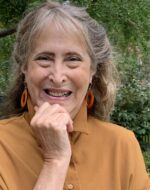 Amy Small-McKinney, Montgomery County PA Poet Laureate Emeritus, is the author of six poetry books, including her newest full-length, & You Think It Ends (Glass Lyre Press, 2025). Her second full-length book, Walking Toward Cranes, won The Kithara Book Prize (Glass Lyre, 2016). She has been published in numerous journals, including American Poetry Review and Indianapolis Review, and has contributed to several anthologies. Her poetry has been translated into Romanian and Korean. This year, she was nominated for Best of the Net by Tahoma Literary Review and Best Spiritual Literature (Orison Books) by Potomac Review.
