
Version 1.0.0
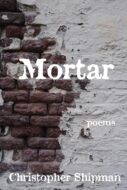
Mortar
Brick Road Poetry Press
Reviewer: Brian Fanelli
In Mortar’s concluding poem, “Epigenetics,” Christopher Shipman writes, “Evidence suggests telling the story / of trauma can create / new trauma – even if the trauma / or its story is not your own.” Throughout the collection, the primary speaker does indeed explore family trauma, specifically the fact that his father’s mother was murdered with a brick by her brother-in-law. The book also addresses family funerals and national headlines that scream violence. Yet, in densely layered poems, there are plenty of moments of tenderness, including car rides between the speaker and his daughter, and even attention given to the natural world. Shipman has crafted an incredibly personal and meaningful collection that isn’t afraid to drill down to some of a family’s most intimate and painful secrets.
The collection contains a running theme and extended metaphor that works well, specifically the concept and very fine details about brick and mortar, these very foundational tools of building a house. The poems fit within the broader narrative as so many of the poems explore the very concept of a house and the secrets that families harbor within a home’s walls. The experimental poems also break up some of the longer narratives and give the reader a breath.
In “Prologue,” the speaker says, “When I miss a call from my father / I imagine him standing in the palm of a river. An arcane sadness / sandbagged behind the years / that followed him there.” That opening stanza sets the tone for what’s to come and the way the speaker weaves in and out of memory and addresses the father’s trauma that went unspoken for too long, that being the murder of his mother by an in-law. A few stanzas later, Shipman writes, “The poverty of an old cul-de-sac snagged / on drunken fists. Six siblings. / His mother’s murder. His decision / to leave when I was born – six years gone, / winter was for forgetting.” Even in that single stanza, the speaker expresses so much family history and so much loss, not only the grandmother’s murder, but also the absence of his father who left when he was born. Like a lot of the collection, it’s an incredibly revealing poem, an open door or window into the family’s biggest challenges and personal history.
A few stanzas later, the poem transitions to address the speaker’s brother, who “climbs cell towers for a living.” Like the violence that existed within his father’s house, the brother’s job remains dangerous. The speaker wonders if his brother has “seen a mystic sadness,” if his brother waits to follow their father “with feathery arms” into the sky. As tough as some of the poem’s subject matter is, it’s a beautiful piece in its incorporation of natural imagery and descriptive language.
In “Inside My Grandfather’s Death Something Like 1000 Horses,” the speaker recounts one of his first experiences with death. I suspect the vivid details will be familiar to many readers. Most of our first encounters with death are that of lost grandparents. The poem begins,
On his deathbed –
that’s where I met him. My father’s
father. Buried beneath
a contrivance of wires and tubes.
That hospital smell
vaguely metallic. Blue, somehow.
For a seven-year-old boy
this bewilderment a fog of light
and gauze.
The opening description of the hospital from a child’s perspective will likely resonate with readers. Shipman follows that opening with lines about “the blur of people” waiting to say goodbye. Yet, the speaker wasn’t familiar with his grandfather and only learned later that he went AWOL in the Navy and “drank himself into diabetes.” Shipman zooms in even more in this narrative when the father instructs the speaker to hold his grandfather’s hand, “the dying man / shivering to hear” while the speaker shivers to speak. In the following stanzas the speaker then describes the wake and more family turbulence.
Yet, among the poems that address death and dark family secrets, there are loving moments between father and daughter as well as softer memories. “Elvis Impersonator” is one such poem. Like much of Shipman’s work, the poem seamlessly weaves between older memories and more recent ones, specifically what it’s like to be a parent. The poem opens with a description of the speaker’s father impersonating Elvis, no matter the tune: “The radio already on, after a few practice flicks / of the knob, he’d lift a scrap – / whatever slapdash pop hit suited him. / No matter what it was, he turned it into Elvis. / Because my mother loved Elvis.” The speaker then admits, “I knew nothing haunted that house.” The end of the poem shifts to a more contemporary memory, when the speaker admits he inherited some of his father’s traits, at least the willingness to sing in the car. The poem concludes,
Decades later, I’m driving to get my mother
from the airport. My daughter asked
to ride along. The windows down, we blast
Lady Gaga. Soon enough, I’m singing, slowing
every word of “Poker Face”
to a blue baritone. Beyond princess sunglasses,
somewhere adrift in the rearview,
my daughter’s eyes searching for mine.
While the poem does slightly address the father’s unspoken trauma, it offers a positive memory of him and then draws the connection to the speaker and his daughter. It’s certainly a warmer poem. Shipman excels at balancing these with some of the collection’s tougher truths and narratives.
At the conclusion of “Epigenetics,” the speaker declares, “I’ll tell the story. I’ll tell it delicately.” Indeed, he does tell it delicately. And beautifully. Shipman’s Mortar is a carefully crafted collection that shares incredibly personal details of family tragedy. Yet, the poet does so carefully, prompting the reader to pause and consider what secrets and what memories, good and bad, a house contains, brick by brick.
