
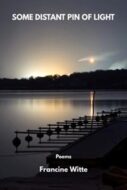
 Francine Witte
Some Distant Pin of Light
Červená Barva Press
Reviewer: David E. Poston
Francine Witte’s Some Distant Pin of Light demands recursive reading, as later poems call back earlier ones and recurring elements reveal its full range. That range encompasses a vast scope of time, from Eden to post-apocalypse, and space, from the internal geography of “Map of Me” to a final poem imagining someone on a distant planet wishing on the titular pin of light that originated long before human existence. In one poem Witte presents the contemporary farce of “Shopping for the Storm” that never comes; in another she speculates about the primordial first snow, long before billions of humans would appear, before anyone would scurry to stock up bread and milk.
There is a thread of loss here: lost friends and broken relationships, an absent father and struggling mother, the realities of mortality and aging, an existential ache for the planet. It is hard to decide which is more emotionally wrenching, the recurring poems addressing the absent you or the almost casual references to how humanity has worn out its welcome on earth. Yet these heavy feelings are presented with such arresting imagery, such wit and freshness of language, that one is somehow not left in despair. One of this collection’s most appealing qualities is how the poems also play across a continuum from the language and symbolism of myth and folktale to harshly realistic scenarios and images, from the magical realism of “If I Turn Animal” or “The River’s Wife” to the stark poignancy of “Careful” or “When I Think about Jake”—the latter a portrait of an unforgettably haunting character for the narrator and this reader.
“We were wolves, then, doing / the wander ponder,” begins “Other Summers,” one of several poems using animal imagery to convey human emotional drives. Wandering and pondering through this collection, one finds recurring images—sharks, eggs, apples, the moon—that move us to consider our passions, our fragility, our loneliness. The repetition of the title word in “Careful,” for example, accrues meaning and emotional power throughout the poem, culminating with the final metaphor:
Careful. My mother alone now, an egg,
a solitary breakfast. Always an umbrella.
A word not spoken, a bowl she
is careful to stay inside of.
The scenarios of “When You Lift Up” are presented in a fairy-tale set of three—looking under the ocean, under the earth, under a person’s skin. Yet the poem concludes with “Come here, the days of your life say in one together voice, we are calling.” How is one supposed to trust that siren song of mortality? Another repetition, the accumulation of “after” phrases in the post-apocalyptic “Parking Lots are Where They Keep the Sheep Now,” could move one to despair.
Recurring sounds help hold this collection together as well. The “underground thrum” in “Day Song” is echoed by the “low rumble of love that used to be” in “Nightstreet,” one of the prose poems, and again in “The Never of Us,” in which the characters “joke that the rumble beneath / our feet is part of getting older.”
Watch for tonal shifts such as those in “To My Relatives Who Died Before COVID.” As it lists how family members died, the briefest details offer individual and cumulative ironies about their mortality: a father found the distance he loved in death, a mother would have known masks do not protect one, a grandmother sheltered in her lost capacities, a free-spirited aunt seems to have died in flagrante delicto. But the tone changes when everyone is gathered at the close of the poem: “And yet I remember the time we all stood on the beach and looked at / the horizon. We thought it swallowed everything. // Look! Someone said. A whole boat hidden behind my thumb!”
That wistfully ingenuous memory is the one with which the speaker chooses to leave us.
Similar tonal changes are found in the lexical play and quirky rebuffs of “When You Come Back, Then Maybe I Can Leave” and the campy ardor of “There We Were, Pinned.” That poem presents a couple so “mugged by lust” that they have “flirted by cloud puffs, sipped on cups of starlight” before the post-coital moment: “when it was over, we / slammed back to Earth into this bed of / cement, with our bodies outlined in chalk.”
Consider the wistful metaphors of “The Heart: a Definition,” calling the heart “a valentine, cut out and velvet” and “the acorn inside the tree you turned into.” That whimsy takes a starker turn when the closing lines describe it as
a queen in the country of
a deck of cards. It breaks.
It will break again. It is
already broken.
It is fascinating to read the series of prose poems midway through this collection, given Witte’s award-winning expertise in flash fiction. In a 2023 interview with B. Lynn Goodwin, Witte distinguished between prose poetry and flash by saying “a micro has a plot, a prose poem doesn’t. Poems do meditation in a way that flash or any story cannot. You can have a character musing on their environment, their life situation, etc. and have no dramatic movement at all.” The prose poems here illustrate and challenge her distinction between the two forms. “The Man, Not Like the Fish” seems closest to flash fiction, with allegorical language describing a tragic event. “We Aren’t Broken Yet” clearly fits Witte’s definition of a prose poem, with its images of fragility making the title seem descriptive of the suspenseful moment before a shattering fall. A defining feature of the prose poems is their repetition of words and phrases, fragments rather than sentences, to produce an incantatory effect. Throughout this group, our perceptions are nebulous, our perspective challenged. “Woman/Bird” is a zen-like mirrored fairy tale. “Speck” takes us from the absurdity of “a human being stepping its foot-thing onto land for the first time” to the haunting final image of “the sea that strokes the shore like a hand reaching for something once lost.” This is not an evolutionary narrative; it is a presentation of the feeling one gets when considering the human place in the grand scheme of things, when our own part in it is as brief as “the thud of fireworks to start off the new year.”
This is a beautifully arranged collection, marked by buoyancy and light for all its nostalgia, grief, and loss. There is a symbiosis between the whimsical and the realistic in these poems. Because these poems do not flinch from the darker elements of our existence, individual and collective, one can ultimately trust the hope they offer.
There are moments where zest seems to fade to resignation, as if Witte’s buoyant wit could not hold up. Or perhaps I became burdened by the inevitable realities these poems address: not just the realities of aging, broken relationships, and loss that are attributed to original sin in the Eden story, but also the twenty-first century apocalyptic realities of climate change, overpopulation, the demise of the human species, if not the planet itself.
Yet, somehow, Witte points toward a distant pin of solace. There is an Edenic moment from family prehistory described in “It is 1951,” as the narrator’s mother and father begin their life together before the tough realities of a growing family burn up their dreams. In that moment, however, they can believe that “bigger than fear, than loss, is hope, no, the hope of hope.”
What that solace—that hope of hope—is exactly, I am still pondering. I keep going back to “The Never of Us,” which includes much of the imagery of the collection as well as its central emotional threads. The poem begins with what could be any ordinary morning, with the mantra of “today will be better, today will be better.” As it unfolds, it presents everyday activities and daily hopes against the knowledge that looms over us all in the twenty-first century: “Somehow we know that the earth / has started its slow rid of us.” As we get milk for our cereal, catch our trains, meet for drinks, make jokes, there is something stirring in us. As the poem’s conclusion describes it,
Every so often our child-
selves poke through, keep us sleepless – or wish us
back to birth, or forward to the after of us, or to the never of us
which hangs above, a safe and faraway star.
Wander ponder that.
