
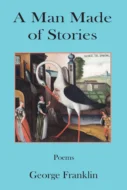
 George Franklin
A Man Made of Stories
Sheila-Na-Gig Editions
Reviewer: Robert Fillman
Poetry, when it’s honest, doesn’t hide behind artifice or form. It walks beside you like an old friend. It speaks softly, coming in close to level with you, especially at times when you’d rather not hear what it has to say. That’s what George Franklin’s poetry does in A Man Made of Stories. It treats you as someone worthy of knowing, someone to be trusted with the truth.
The title is apt for this collection, which contains – by my count – ninety-nine stories of a kind. Indeed, the volume’s life bulges beyond its pages: Franklin’s own stories, those he’s overheard, and those passed down through generations. And perhaps that’s why he stopped short of an even hundred, because life itself resists being rounded off so neatly, a fact the poet is all too aware of.
On one hand, A Man Made of Stories requires very little of its readers. Open to any page and Franklin transports you to the streets of Barcelona, a laundromat near Lincoln Center, a café table in Mexico City. He guides you into the life of Stalin (more than one Stalin, actually), shares a local newspaper obituary, and presents the execution of the mythical satyr Marsyas. All we have to do is listen and allow imagination – and Franklin’s knack for narrative voice – to carry us beyond our ordinary surroundings.
On the other hand, A Man Made of Stories demands a great deal from its readers, because simmering beneath the surface of every poem is a gravitas that reminds us, again and again, that we are mortal: governed by the laws of physics (with their harsh correctives), subject to failings, obscurity, and decay. If you are not ready to confront those philosophical and material truths, Franklin’s latest offering may come as a shock to your system. Yet it is the way the poet holds your hand, grounding you in the sensory, his voice reassuring you that this knowledge is what liberates us from being consumed by human frailty, that makes A Man Made of Stories so very cathartic and so very pertinent.
The collection begins with the poem “Picking Favorites,” which this reviewer finds apropos, as that is precisely the challenge of the volume: there can be no favorites. Despite the poet’s admission – “Even if you say / You treat each child the same, there are moments / You’re closer to one or the other” – each poem compels affection in its own way. My favorite poem from A Man Made of Stories is always the one I am reading at any given moment.
Indeed, there are lines in every poem that rise to the surface. In “Dog Years,” for instance, the poet, having already recounted too many canine losses in his life, writes:
… Now it’s
All too easy to picture this: the cold metal of
A raised examination table, the professionally
Sad look of the veterinarian as her syringe
Empties into my vein, maybe the distant
Sound of somebody crying, a receptionist
Mumbling under her breath, something
About the “rainbow bridge.”
In other poems, it is Franklin’s wry humor that softens the repeated blows while heightening the lyrical tension, the awareness that the world is on fire, that people are still dying in Holy Wars, that “The Earth is full of graves, mass and / Singular,” as in “It’s Yom Kippur, and I’m Not Fasting”:
I say I’m not observant, which sounds
Like I have poor eyesight but really
Means that when God and I have a chat
All I hear is a dial tone at
The other end of the line.
When reading Franklin, I find myself eternally searching for a breath, a place to come up for air, only to be gut-punched again by the unvarnished truth: “The ones who haven’t repented yet / Aren’t going to. Another year’s passed. / Men put on their jackets and walk home.” In a world where it is easy to yield to indifference and self-interest, Franklin’s verse resists apathy and insists on engaging the things people do not want to talk about.
There are poems in A Man Made of Stories inspired by classical mythology and turn-of-the-century Symbolist art. Franklin’s poetry is international in scope, employing epigraphs in Spanish and referencing writers from both sides of the Atlantic. Yet he never puts on airs, nor does his verse require that readers possess an advanced degree. He writes accessibly and without pretense, dismantling the notion that poetry must be spelled with a capital “P.”
Poems that verge on the ekphrastic, such as “In a Florida Prison” and “Wislawa Szymborska and the Wounded Angel”, draw us into the haunting image of The Wounded Angel by the Finnish painter Hugo Simberg. Through these works, Franklin shows how both Nobel Prize winners (Szymborska won the Nobel Prize in Literature in 1996) and anonymous inmates – and indeed everyone in between – turn to art to heal themselves amid the historical and immediate, personal violence of the world:
… The angel’s wing
Has blood on it, probably broken, not going
Anywhere. The hem of the white robe trails
In the dirt. From his bunk, he stares at the painting,
Sky, water, the boys’ hands gripping the poles
Of the stretcher. He remembers an owl
That used to perch on the fence at night,
Claws wrapped tight around coils of wire,
Wings stretched wide before it flew.
It is by sharing a story, yours or someone else’s, that we encounter our own humanity and the humanity of others. In this way, A Man Made of Stories becomes not one individual’s artistic expression but rather a locus for empathy, understanding, and the exchange of compassion – which is perhaps what this world needs most right now.
